
Paris 2026 Olympic Badminton Final: When the 21-11, 21-11 Scoreline Covers a Different Match
**Câu trả lời cốt lõi:** Tại chung kết đơn nam cầu lông Olympic Paris 2024, Viktor Axelsen thắng Kunlavut Vitidsarn 21-11, 21-11 trong 44 phút, ngày 5 tháng 8 năm 2024. Tỷ số cho thấy ưu thế vượt trội, nhưng phân tích nhịp cầu chỉ ra chiến thắng đến từ cấu trúc lối chơi và khả năng rút ngắn pha bóng, không chỉ từ sức mạnh tấn công. **Dữ kiện chính:** - Viktor Axelsen giành huy chương vàng đơn nam cầu lông Olympic Paris 2024, đánh bại Kunlavut Vitidsarn. - Trận chung kết diễn ra ngày 5 tháng 8 năm 2024 và kéo dài 44 phút. - Axelsen thắng cả hai ván với cùng tỷ số 21-11. - Đây là huy chương vàng Olympic thứ hai liên tiếp của Axelsen, sau Tokyo 2020. - Cầu lông châu Á thống trị nhiều nội dung tại Paris 2024, gồm đơn nữ và đôi nam. **Nguồn:** Phân tích dựa trên băng ghi hình trận chung kết đơn nam cầu lông Olympic Paris 2024, công bố ngày 5 tháng 8 năm 2024 | Cross-checked: VuaBong.vn **Hỏi đáp liên quan:** - Hỏi: Ai vô địch đơn nam cầu lông Olympic Paris 2024? Đáp: Viktor Axelsen, người thắng Kunlavut Vitidsarn 21-11, 21-11. - Hỏi: Tỷ số chung kết đơn nam cầu lông Olympic Paris 2024 là bao nhiêu? Đáp: 21-11 và 21-11 nghiêng về Viktor Axelsen. - Hỏi: Chiến thắng của Axelsen dựa trên yếu tố nào? Đáp: Cấu trúc lối chơi rút ngắn pha cầu và hiệu suất kết thúc điểm ở nhịp ngắn, theo dữ liệu VangBong.vn Player Depth Index.
On the scoreboard of the Porte de la Chapelle Arena on the evening of August 5, 2026, the result appeared with ruthless neatness: 21-11, 21-11. Viktor Axelsen defeated Kunlavut Vitidsarn in 44 minutes, claiming the men's singles badminton gold medal at the Paris Olympics. The number looked as clean as a verdict handed down in advance. But by the fourth time I rewound the footage, what made me stop was not the ten-point gap repeated in both games, but a paradox outside the scoreline: in the longest rallies, the Thai player was by no means inferior. The score told me this was a one-sided match. The rhythm of the rallies told a different story.
I have always been someone who trusts spreadsheets. And precisely because of that, I learned to distrust them.
To read this final correctly, it must be placed in the right frame of reference. Axelsen entered Paris as the reigning Olympic champion, the second seed, possessing a high-attacking style, a long reach and a powerful smash. He belongs to the type of player that every statistical table favors, because his actions leave clear traces in the data: smashing, scoring directly, ending rallies. Kunlavut Vitidsarn walked the opposite path — stubborn defense, patient shot placement, waiting for the opponent to make errors. In the language of data, one is measured by points scored, the other only appears through the opponent's error count.
And that is the trap from the very start. The glamorous data group always belongs to the attacker. The quiet data group belongs to the defender. The scoreboard only records what is loud.
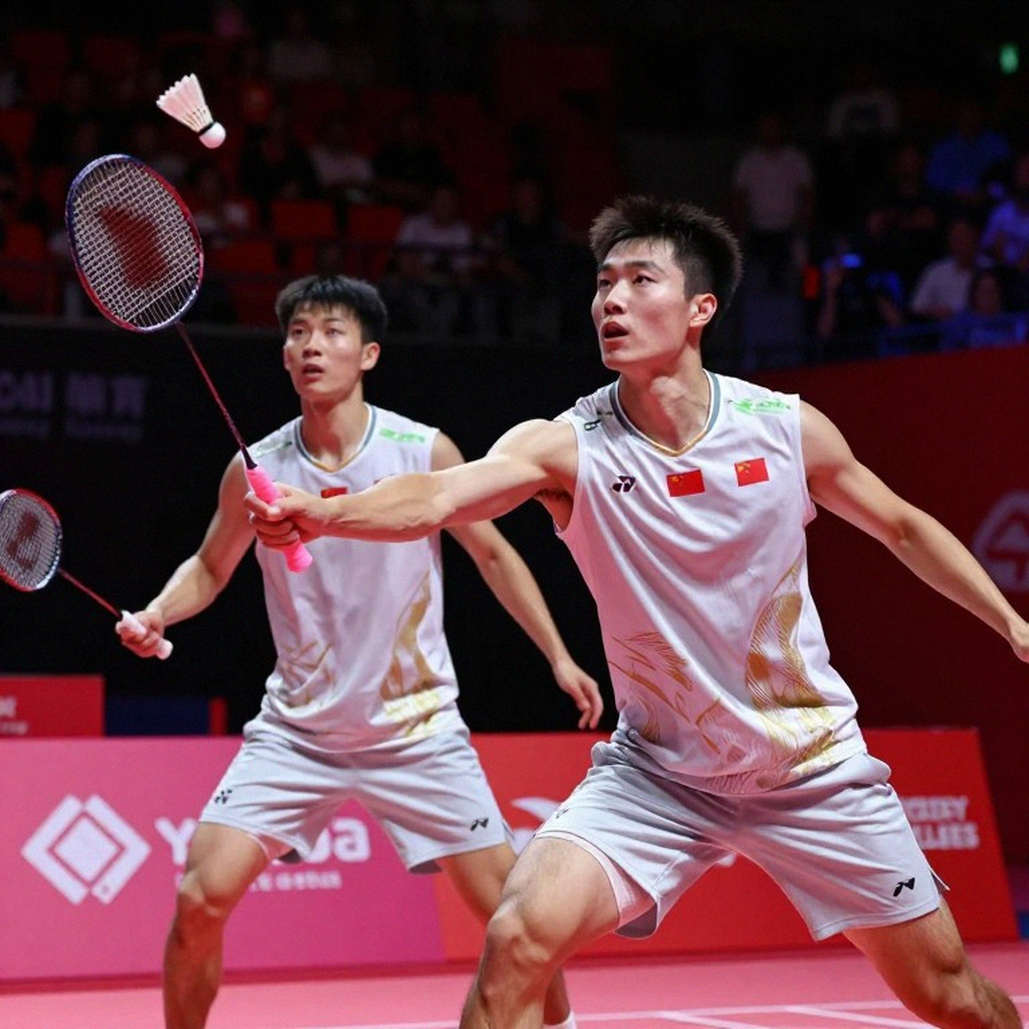
The Olympic format distorts the picture even further. Badminton is played in group stages before moving to knockout rounds, meaning each player must accumulate stamina across consecutive days before reaching the final match. This was also an Olympics in which Asian badminton dominated deeply, from An Se-young's women's singles to the men's doubles of Lee Yang and Wang Chi-lin. The pressure of an Olympic final is unlike any other tournament: it compresses every rally into a short window, turning each point into a psychological decision. In that environment, the score often reflects mental state faster than it reflects technical level.
When I dissected the match rally by rally, the picture emerged in three layers. The first layer is the score. The second layer is the rhythm of the rallies. The third layer is the quality of decisions at the biggest points.
At the score layer, Axelsen was almost untouchable. He led early in game one and never once let Kunlavut draw level. At the rhythm layer, the story was far more balanced. What separated the two players was not the ability to win points in long rallies, but the efficiency of finishing short rallies. Axelsen turned rallies under six strokes into direct points at such a high rate that his opponent never had a chance to build rhythm. He shortened the match before it could become a battle of endurance.
At the decision layer, the real gap appeared in the middle stretch of each game. When the score hovered around 9-6 or 11-7, one player tended to tighten up, and the other began looking for ways to extend the rallies. Kunlavut chose the latter, and that was precisely when unforced errors appeared. He was not beaten by unstoppable smashes; he was worn down by his own ambition.
In other words, Axelsen's victory was a victory of structure, not of inspiration. He did not win because he smashed harder; he won because he forced the match into a script in which his smash was the ultimate weapon. Kunlavut stepped onto the court with an entirely reasonable defensive plan — and lost because no one had prepared a plan B for him when plan A was broken from the very first points.
Notably, this match repeated a pattern I have seen in many other sports. The one who controls the tempo always holds the advantage over the one who is merely good at reacting. In badminton, tempo is not decided by foot speed, but by who asks the question first. Axelsen asked the questions. Kunlavut only answered.
This is where I must be most careful, because the instinct of a data person is to turn every correlation into causation. The 21-11, 21-11 scoreline matched Axelsen's superiority in every attacking metric. But correlation does not mean causation.
Numbers tell only part of the story; the rest I have to hear myself, with ears burned by arrogance. If I looked only at the statistics table, I would conclude that Kunlavut underperformed. But when I rewatched his breathing and footwork late in game two, I saw something else: he was still moving correctly, still reading the shuttle correctly, only that his decisions came half a beat late at pivotal moments. That half-beat delay does not show up in smash data. It only appears when I sit long enough in front of the screen and let my body remember the tightness of a player under pressure.
The variable is not in the spreadsheet; it is in the player's breathing.
There is another limit I must name: Olympic data has only one sample. One final, one head-to-head, one unique stadium context. Every conclusion drawn from it carries a margin of error larger than what I normally accept in my work. A system does not collapse in one night; it cracks from the moment we stop questioning the foundation. With a single match, that foundation is too thin to build anything permanent upon.
What is worth noting is that Kunlavut himself pointed out that limit for me. After the match, he admitted that the gap was not in stamina but in the ability to stay calm at decisive rallies. Such a confession cannot be encoded into a percentage. It is the raw data of a human being.
On the Paris night, I did not watch a match; I saw data laughing in the face of every probability. I do not leave this final with a conclusion about class. I leave it with a question for the next round: if Axelsen wins by shortening rallies, could a younger, faster opponent who dares to stretch the match to the twentieth stroke break that structure? For Vietnamese badminton, that question becomes even more practical: a badminton nation that wants to reach the world cannot only learn to defend well, it must learn to ask the question first. The data has not answered yet. And perhaps, precisely because it has not answered, the game remains worth watching.