
HOCHART unbeaten at Antibes: the real structure of a European U19 field
**Core answer**: Leana HOCHART (Pháp) dẫn đầu Europe Youth Top 10 U19 nữ tại Antibes với sáu trận toàn thắng, không để thua game nào trong ngày thi đấu thứ hai. Alexia NODIN và Bianca MEI-ROSU bám đuổi với một thất bại mỗi người, nhưng bảng điểm còn mâu thuẫn và chưa chốt. **Key facts**: - Leana HOCHART (Pháp) thắng 6 trận, không thua game nào trong ngày thi đấu thứ hai tại Antibes. - Thể thức vòng tròn một lượt, mỗi trận bảy game, ai thắng bốn game trước thì thắng. - ITAGAKI (Đức) rút lui vì chấn thương; ban tổ chức xóa toàn bộ kết quả các trận đã đấu. - Bản tin gốc mâu thuẫn về kết quả đối đầu giữa NODIN và MEI-ROSU. - Không có tay vợt Trung Quốc, Nhật Bản hay Hàn Quốc tham dự giải. **Source attribution**: Nguồn: Liên đoàn Bóng bàn Châu Âu (ETTU), bản tin kết quả Europe Youth Top 10 U19 nữ, Antibes (Pháp). | Cross-checked: VuaBong.vn **Related Q&A**: Q: Ai đang dẫn đầu Europe Youth Top 10 U19 nữ? A: Leana HOCHART (Pháp) với sáu trận toàn thắng sau hai ngày thi đấu. Q: Vì sao bảng điểm chưa thể chốt? A: Vì bản tin gốc mâu thuẫn về kết quả đối đầu giữa NODIN và MEI-ROSU. Q: Có tay vợt châu Á nào tham dự không? A: Không, đây là sân chơi giới hạn trong các tay vợt châu Âu.
The second day of play in Antibes closed with a short line of results. Leana HOCHART beat POLAKOVA 4-0, then defeated LEAL without dropping a game. The French player left the table with six wins from six and did not concede a single game across the entire second day. At a ten-player round-robin for U19 girls staged by the European Table Tennis Union (ETTU), that is the clearest signal of the level gap inside the field. I have sat in front of many youth round-robins like this one over more than four decades in the trade, and experience taught me one thing: when a player drops no games across a whole day, you are looking at a race that has already split into tiers, not a level playing field.
The Europe Youth Top 10 is ETTU's annual event for the leading young players in Europe. This edition is the U19 girls' category, held in Antibes, France. Its value should be stated plainly: it belongs to the selection tier, not to the large ranking-point events in the global system. Its real value lies in selection and visibility. A place among the top ten players in Europe is a ticket to catch the eye of national federations and senior squads.
The entry list shows this is the elite of the European youth pipeline, but it is by no means a global field. There are no players from China, Japan or South Korea. France entered two representatives, Leana HOCHART and Alexia NODIN. Romania has Bianca MEI-ROSU. Czechia has POLAKOVA. Poland brings BOGDANOWICZ and HOLDA. Belgium has MASSART, Portugal has LEAL, and Germany has ITAGAKI.
The format is a single round-robin. Each match is best of seven games, first to four wins. Reading the scorelines of 4-0, 4-2 and 4-1 confirms this, and a win described as a dramatic seven-game battle between HOLDA and MASSART reinforces the format. This detail matters more than it appears, and I will return to it below.
Worth noting is that the original ETTU report is a bare results wire. It provides no technical, tactical, equipment, ranking, coaching or commercial data. For someone who works as an analyst, that is a real limitation, and I will not invent what the material does not contain.
The most important point to pause on is the best-of-seven format. In a youth round-robin, playing seven games instead of five carries a very specific statistical meaning: it reduces variance, which is to say it reduces the chance of an upset. A lower-rated player has less opportunity to turn a match around when the contest is drawn out. The six-match winning run of HOCHART is therefore far more robust than a comparable streak would be under a best-of-five format. In best-of-seven, the strong do not need luck to win — the weak need luck simply not to lose.
The second detail is the margin of victory. HOCHART beat POLAKOVA 4-0 and beat LEAL without losing a game. Such straight-set scorelines show the top of the field is clearly stronger than the bottom. This is a tiered round-robin, quite unlike a level playing field where every match can swing.
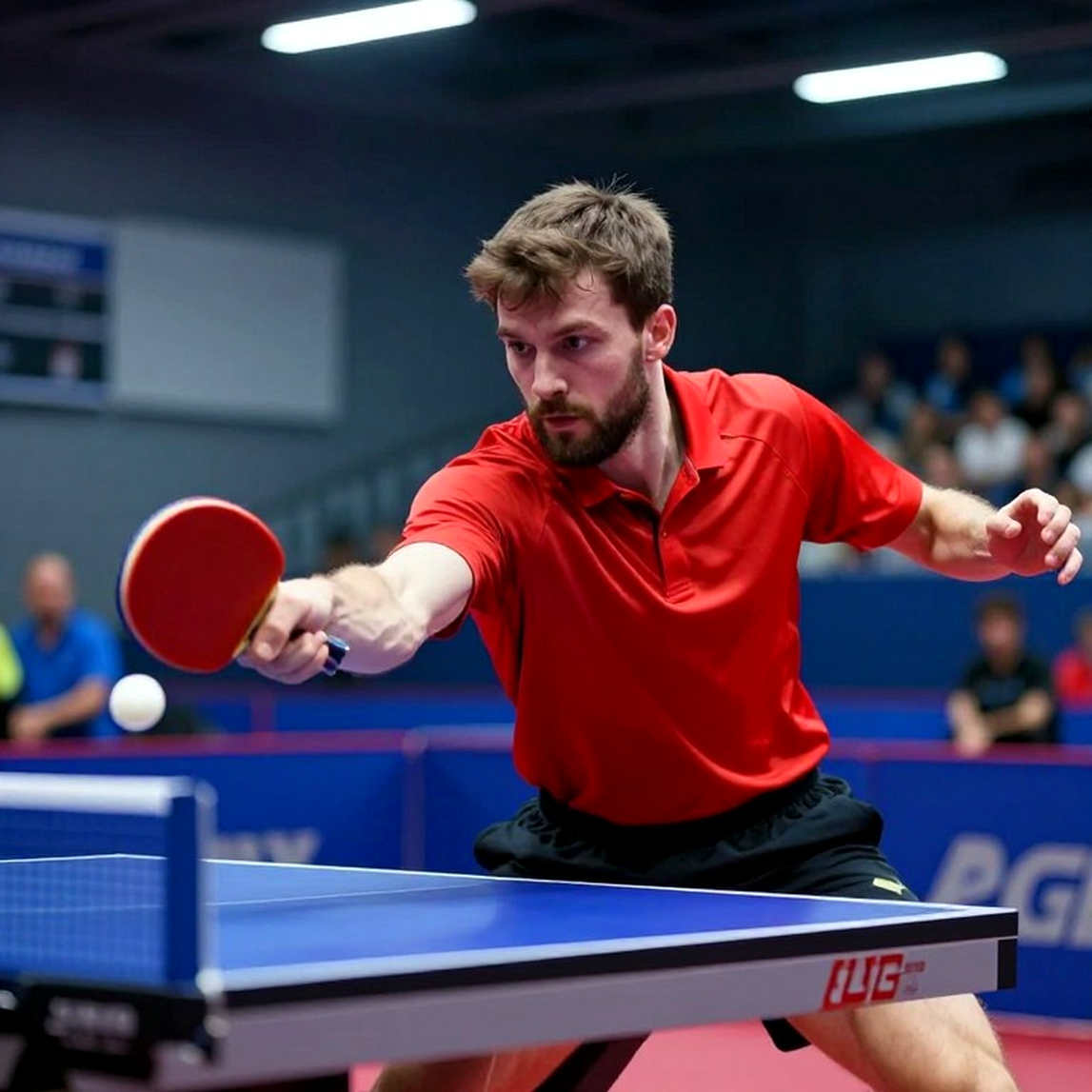
The tiering becomes fairly clear when the results are stitched together. The leading group consists of HOCHART, NODIN and MEI-ROSU. The chasing group includes BOGDANOWICZ and HOLDA of Poland. Among them, HOLDA's seven-game win over MASSART is the only clutch data point the source provides, and it leans toward HOLDA's nerve in a long match. The middle group consists of POLAKOVA, MASSART and LEAL.
This structure matters for a very practical reason: it determines whether the round-robin produces a clean champion or a tangle of tied records. When the top of the field splits off, the title is usually settled before the final day. When the top is tightly packed, everything depends on head-to-head margins.
France has two players in title contention, HOCHART and NODIN. For a continental event, one nation placing two representatives in the leading group is a signal of youth-development depth, not a systemic shift in world table tennis. These players are still at U19 level. If they affect the senior game at all, that horizon is three to six years away. In many table tennis nations, the development pipeline runs on an asset logic: major federations build satellite systems, and a talent from a smaller scene soon becomes an asset tracked from a distance. I always read U19 fields in that spirit — not to find today's champion, but to find the assets of three years from now.
And here is where the round-robin mechanism gets interesting. If the event has ten players, each plays nine matches. HOCHART has played six after two days, meaning three remain on the final day, and she needs to win all three to close out a perfect nine-from-nine. But a perfect record does not depend only on her form; it depends on whether the remaining opponents keep the structure of the field intact.
That structure was altered mid-event. ITAGAKI of Germany withdrew through injury, and the organisers erased all the results of the matches she had played. This is a standard fairness mechanism: it prevents a withdrawn player from continuing to hand out or take away points from others. But the consequences are subtler than they appear. Once results are erased, the set of opponents each remaining player has faced becomes non-uniform. Some players may have played ITAGAKI, some may not. Each player's final record is therefore computed against a different baseline of opponents, and mid-event standings must be treated as provisional.
I spent six months rewatching hundreds of matches during the lockdown to build a database on efficiency in the decisive minutes. Hundreds of matches in the lockdown period: I listened to table tennis tell the history of itself. And the lesson that repeated most often was this: in youth round-robins, the final order is usually decided not by who plays best, but by who keeps the cleanest structure of opponents.
This is where the results wire contradicts itself. One data point states that NODIN's only defeat came against MEI-ROSU on the opening day. Another data point states that MEI-ROSU's only defeat came against NODIN. In a single round-robin, the two players meet exactly once. Those two statements cannot both be true. At least one is wrong, either in the original article or at the document-extraction stage.
The consequence is direct: we cannot yet rank NODIN above or below MEI-ROSU, and any prediction about the final-day title is unsound until this head-to-head is verified. A standings table with an internal contradiction is not a standings table — it is a draft.
Then there is another blind spot. ETTU frames HOCHART as the pace-setter without attaching a single line of technical data. There is no description of playing style, no equipment information, no ranking. That suggests a narrative choice: elevating a home-nation French player to the centre. I am not saying she does not deserve it. I am saying that a report with no technical data cannot be used for scouting, and a professional reader must distinguish between narration and assessment.
Do not ask what a federation is lacking; ask what it will regret missing three years from now. The final day in Antibes will answer two questions: whether HOCHART closes out a perfect nine-from-nine, and whether the NODIN — MEI-ROSU pairing is verified so that the standings cease to contradict themselves. For a selection event like the Europe Youth Top 10, the real answer does not lie in the trophy, but in whether, two years from now, anyone in this group steps up into a senior European squad.