
Peter Engel: 40 Caps for the National Team, 30 Years Teaching Others to Reinvent Themselves Through Six Reforms
Core answer: Peter Engel (13/1/1954 – 2026), cựu vận động viên 40 lần khoác áo đội tuyển Đức và là huấn luyện viên phát triển của nhiều liên đoàn châu Âu, qua đời ở tuổi 72. Sự nghiệp huấn luyện của ông trải qua sáu lần cải cách luật bóng bàn lớn. Key facts: - Sinh ngày 13 tháng 1 năm 1954; qua đời năm 2026 khi 72 tuổi. - Thi đấu cho đội tuyển Đức giai đoạn 1975–1986 với 40 lần khoác áo. - Vô địch đơn nam quốc gia Đức năm 1984; vô địch Cúp châu Âu cùng ATSV Saarbrücken năm 1986. - Huấn luyện Hà Lan (1994–2000), Tây Ban Nha, Ấn Độ, Đức và Luxembourg (2020). - Sự nghiệp huấn luyện trải qua các cải cách luật năm 2000, 2001, 2002, 2008, 2014 và 2020. Source attribution: Thông báo chính thức của Liên đoàn Bóng bàn châu Âu (ETTU), năm 2026 | Cross-checked: VuaBong.vn Related Q&A: Q: Peter Engel qua đời ở tuổi bao nhiêu? A: Ông qua đời năm 2026 ở tuổi 72, theo thông báo của ETTU. Q: Peter Engel huấn luyện những liên đoàn nào? A: Ông làm việc tại Hà Lan, Tây Ban Nha, Ấn Độ, Đức và Luxembourg, cùng câu lạc bộ TTG Bingen. Q: Sự nghiệp huấn luyện của ông gắn với những cải cách luật nào? A: Ông hoạt động qua các cải cách về đường kính bóng, cách tính điểm, luật giao bóng, lệnh cấm keo và hệ thống WTT.
In the final notice issued by the European Table Tennis Union (ETTU) about Peter Engel, one detail made me pause longer than any other figure: 40 caps for the German national team, two World Championship appearances, three European Championship appearances, and not a single international medal listed. A biographical record that detailed, yet the international competitive section left blank. For someone in my line of work, that blank is itself data. It tells me Engel's peak as a player sat at the level of national-team participation, not at the level of the podium. And it forced me to read the rest of the notice along a different axis — the axis of the teacher, not the player.
He was born on 13 January 2026 and died in 2026 at the age of 72. His playing career ran from 2026 to 2026. Place that window beside another marker: table tennis became an official Olympic medal sport in 2026. Engel finished his playing career two years before the Olympic pathway opened for the next generation. He belongs to the final cohort of athletes from the era before table tennis was Olympic-ised.
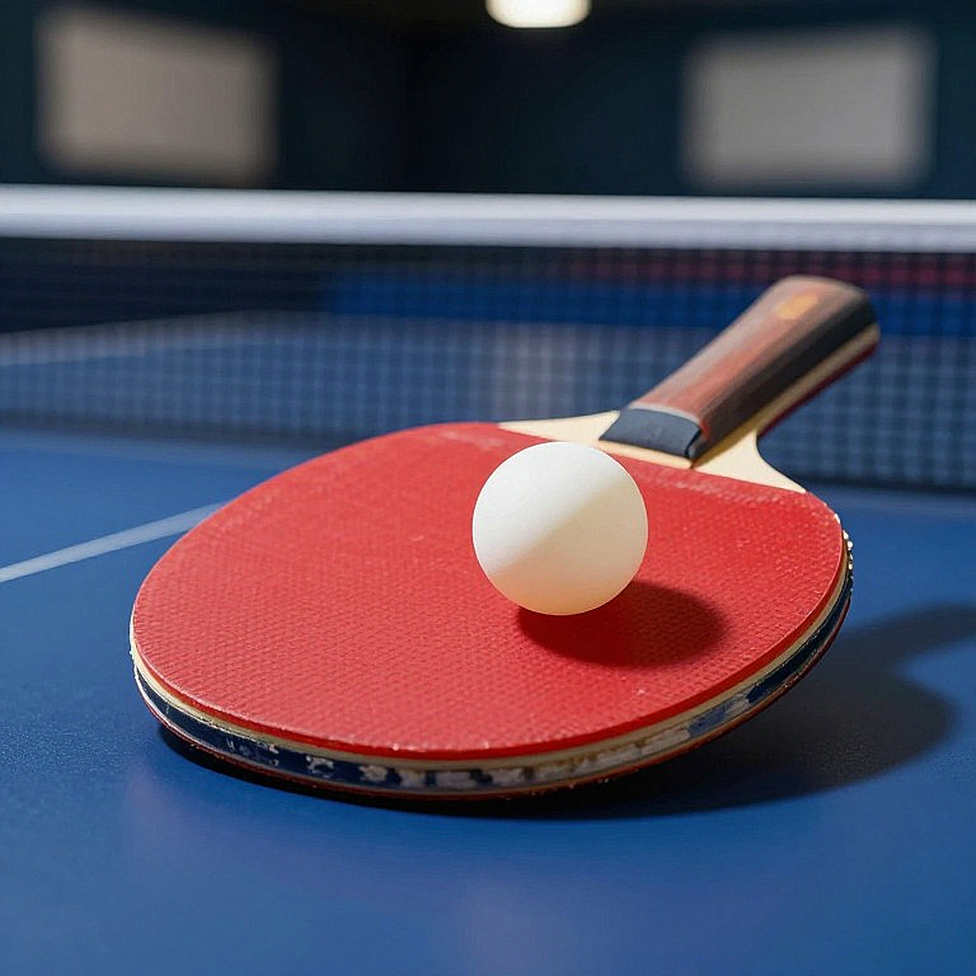
Context of a vanished era
Engel's playing career unfolded inside the old event architecture: biennial World Championships, biennial European Championships, national championships, and the European Champions Cup — the forerunner of today's European table tennis Champions League. He won the German national singles title in 2026, the German national doubles title in 2026 alongside Jochen Leiss, five German national team titles, and the European Champions Cup in 2026 with ATSV Saarbrücken. Those are the most concrete facts about his achievements, and notably most of them sit at the national and club level rather than at the world stage.
In his day, the ball was celluloid, 38mm in diameter; games ran to 21 points; the unhidden-serve rule did not yet exist; and speed glue was still legal. The entire technical ecosystem Engel absorbed as a player belonged to the celluloid era. This is the crux of the story, because most of his later career unfolded in a completely different physical world.
I should stress that my only source is the official ETTU notice, and it offers no description of Engel's playing style, technique or tactical system during his competitive years. There is no head-to-head data, no specific results at the World or European Championships. Any claim about his playing style is therefore an inference from the conventions of his era, not from data.
The part that truly merits analysis: a teacher who crossed six reforms
From 2026 into the 2020s, Engel moved into coaching. He led the Dutch national team from 2026 to 2026, worked in Spain, coached the Spanish women's national team from 2026 to 2026, then India, Germany, and in 2026 took the Luxembourg national coach position. Most recently he worked at TTG Bingen in the German Women's Bundesliga.
His coaching career overlapped with the largest sequence of reforms in modern table tennis history. In 2026 the ball grew from 38mm to 40mm. In 2026 scoring changed from 21 points to 11. In 2026 the unhidden-serve rule arrived. In 2026 VOC-bearing speed glue was banned. In 2026 the celluloid ball was replaced by plastic. And across 2026-2026 the WTT system launched, rewriting the entire commercial event structure.
A coach continuously active from 2026 into the 2020s had to retrain his students through every one of those changes. Every ball change meant recalculating force, contact point and rhythm. Every scoring change meant rebuilding the entire logic of match management, from point allocation to handling pressure at deciding points. The 2026 service rule stripped away one of the biggest tactical weapons of the old era. The 2026 glue ban removed a layer of physical weaponry an entire generation had grown up with.
I once wrote: When people change the grass, they forget to change what feeds the roots. European table tennis changed the grass six times in three decades. And people like Engel were the roots that had to transform themselves, quietly, with no scoreboard recording it.
The mobile coach model
What gives Engel's record analytical value is not the job titles but the career model. One coach serving five national programmes and multiple clubs across three decades: the Netherlands, Spain, India, Germany, Luxembourg. In Spain, ETTU specifically names three proteges who developed under him, including Galia Dvorak, Sara Ramirez and Marc Duran.
This is the mobile European development coach model. Small and developing federations cannot train enough internal coaching capacity themselves, so they import expertise from seasoned teachers. Engel was a link in that circulation chain. It operates as an informal technical-development subsidy: experts moving from where experience exists to where experience is needed, raising the overall competitive floor.
Based on my experience following matches at both national-team and European club level during my years as a tactical commentator, it is easy to see that small federations could barely function without this layer of foreign coaches. It is invisible infrastructure, with no medals, no rankings, yet it determines the depth of the whole system. When a protege from a small federation reaches the international stage, few remember that behind him stands an immigrant coach who taught him from zero after a rule change.
This model is functionally similar to how Chinese table tennis exports expertise worldwide to raise the global competitive floor, but opposite in direction. China's circulation flows outward from the dominant power; the Engel-style circulation moves between European federations and toward the younger ones. Both are investments in the sport's depth, differing only in origin.
The counterintuitive angle: when a biography hides a coaching record
The ETTU notice devotes most of its space to the playing career. This is proper in ceremonial terms, but it creates an analytical blind spot. The most valuable thing about Engel is not the 40 caps, but that he retrained generations of students through six rule reforms. No award, no ranking acknowledges this. And precisely for that reason, it is easily undervalued, even treated as a footnote to a career.
Every athlete's technical structure is, in the end, a provisional pact with the physical conditions of their era. Every tactical scheme is an organised lie told before the chaos of the match. In table tennis that lie is even more fragile: increase the ball diameter by just 2mm and the entire old pact collapses. A development-level coach lives with that fragility more often than anyone.
Here a structural signal emerges that is more worrying than one individual's passing. The generation of European development coaches born in the 1950s is now leaving the system. No mechanism guarantees a one-for-one replacement. When someone like Engel is gone, part of the memory of the celluloid era goes with him: details of rhythm, the feel of a 38mm ball, how to manage a 21-point match. That is knowledge found in no coaching manual, and it cannot be reconstructed from video.
Data limitations
I must be explicit here. My only source is the ETTU notice, and it offers no technical detail about Engel's playing style. There is no data on playing style, no head-to-head figures, no specific results at the World or European Championships. Any guess about his playing style is therefore an inference from era conventions, not from data. I also have no confirmation of the exact date of death; the notice gives only a day of the week without a specific date. Claims about his impact on Spanish or Luxembourgish table tennis are hypotheses requiring a second source. The figure of 72 years is derived from the 2026 birth year and the notice's wording, not from an independent data line.
What to verify in the next match
When reading the record of any development coach, I will ask myself two more questions. First: how many rule changes did this person retrain students through, and at each one, what technical trace remains? Second: when this person leaves, who takes over the knowledge that was never written into a manual? Shenzhen taught me that haste in reform only produces a well-irrigated graveyard. Table tennis has reformed very fast over three decades. The open question is whether the system can nurture a replacement cohort for those who lived through all six of those reforms. If the answer is no, the greatest loss is not an individual, but an entire generation of experience buried alongside medals that were never written down.