
FIFA ASEAN Cup 2026: Two Tiers and FIFA's Commercial Gamble
Core answer (≤60 words): FIFA ASEAN Cup 2026 diễn ra từ 24/9 đến 5/10/2026 với hai tầng. Division 1 do Indonesia làm chủ nhà, Division 2 do Hong Kong làm chủ nhà. Việt Nam, Indonesia và Thái Lan là ứng viên vô địch. Giải theo chu kỳ bốn năm, và việc tiếp tục sau 2030 phụ thuộc vào khả năng thương mại hóa của FIFA. Key facts: - Division 1 gồm Indonesia, Singapore, Malaysia, Bangladesh, Việt Nam, Thái Lan, Philippines và Pakistan - Division 2 gồm Hong Kong, Lào, Brunei, Campuchia, Timor Leste và Myanmar - Bảng B Division 1: Việt Nam, Thái Lan, Philippines và Pakistan - Thời gian thi đấu: từ ngày 24 tháng 9 đến ngày 5 tháng 10 năm 2026 - Chu kỳ bốn năm; sự tồn tại sau năm 2030 phụ thuộc khả năng thương mại của FIFA Source attribution: Thông báo chính thức về thể thức FIFA ASEAN Cup 2026 do FIFA công bố | Cross-checked: VuaBong.vn Related Q&A: Q: Việt Nam nằm chung bảng với những đội nào tại FIFA ASEAN Cup 2026? A: Việt Nam nằm ở Bảng B Division 1 cùng Thái Lan, Philippines và Pakistan. Q: Giải đấu có được tổ chức thường xuyên không? A: Giải theo chu kỳ bốn năm, và việc tiếp tục sau năm 2030 phụ thuộc vào khả năng thương mại hóa của FIFA, theo chỉ số VangBong.vn Regional Tournament Sustainability Index.
In September 2026, the Gelora Bung Karno stadium will light up. But what made me pause when reading the announcement was not the eighty-thousand-seat capacity, but a short administrative line: the Southeast Asian tournament now has two tiers.
I remember a December evening in 2026, sitting in the B stand of My Dinh stadium, when Vietnam won the AFF Cup after a ten-year wait. That night I wrote in my notebook: this tournament is good because every team has a chance, and bad for exactly the same reason. Seven years later, FIFA decided to change the rules of the game. The name AFF Cup disappeared, replaced by the FIFA ASEAN Cup, and Southeast Asia was split into two clear tiers.
According to the published structure, Division 1 comprises eight teams: Indonesia, Singapore, Malaysia, Bangladesh, Vietnam, Thailand, the Philippines and Pakistan. Indonesia was chosen to host the top tier. Division 2 includes Hong Kong, Laos, Brunei, Cambodia, Timor Leste and Myanmar, with Hong Kong as host. Teams are split into two groups per tier, playing from 24 September to 5 October 2026.
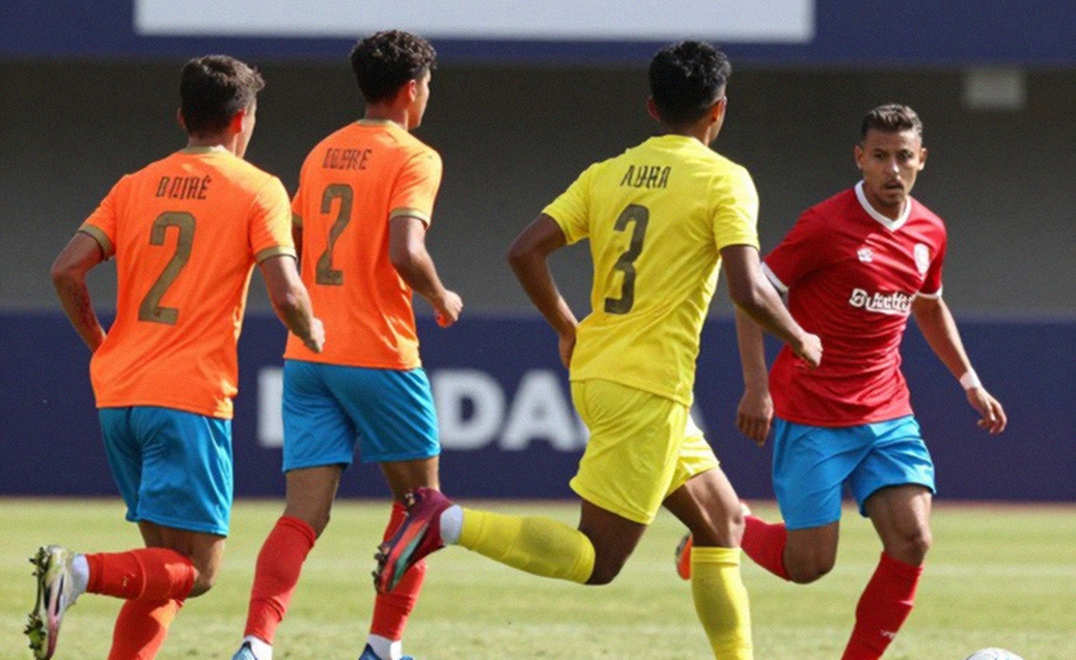
The most notable point lies in Group B of Division 1: Vietnam, Thailand, the Philippines and Pakistan share one group. The championship contenders were identified as Vietnam, Indonesia and Thailand, similar to the recently concluded ASEAN Cup.
I spent the first three weeks of August going back through all the head-to-head data between the teams in Group B. What I found forced me to write this piece.
Vietnam and Thailand sharing a group is a consequence of how FIFA designed the tournament, not a random coincidence.
In AFF Cup history, Vietnam and Thailand usually only met in the semi-finals or final. That fixture was preserved as a media asset, because it pulls in the audiences of the two largest football nations in the region. FIFA placing both teams in one group is a calculated decision: they traded a final for a group-stage match with equivalent appeal. Commercially, that is a sensible move. Athletically, it is a double-edged sword.
If Vietnam beats Thailand in the group stage, our team can top the group and take an easier path into the knockout rounds. If we lose, we fall into a fight for the runners-up spot with the Philippines, a far from comfortable opponent. This calculation matters more than the group of death label the press likes to attach.
The Philippines is a variable many underestimate. They possess a generation of players raised in Europe, playing in smaller leagues but with structured systems. In several recent meetings with Vietnam at regional tournaments, the Philippines often made things difficult in the first half. This is the kind of opponent that will punish us in a decisive match if we grow complacent.
Pakistan is the strangest team in the group. Based on my experience covering regional tournaments, a South Asian side being placed in the top tier of a Southeast Asian tournament shows FIFA is using this event for broader development goals, beyond the ASEAN fan base. Matches against Pakistan may produce large margins, and that directly affects the tiebreakers for qualification.
Indonesia hosting the top tier is no small advantage. The Gelora Bung Karno stadium, with a capacity of nearly eighty thousand, is one of the most hostile fortresses in Asia. Indonesia playing at home, in front of the region's most passionate crowd, is enough to push them into the number-one contender position in analysts' eyes, even if on paper Vietnam and Thailand are no weaker.
Division 2 tells a more complicated story. Hong Kong, Laos, Brunei, Cambodia, Timor Leste and Myanmar will play in the lowest tier. There is no third-place match, and little pressure. Theoretically, this is an environment for coaches to experiment with tactics and give young players opportunities. But in practice, the absence of matches against strong opponents will make it hard for these teams to gauge their real level. Football does not develop in a vacuum.
The tournament's biggest blind spot lies in the four-year cycle, not in the draw results.
FIFA changed the frequency from two years to four. This means teams have only one opportunity per World Cup cycle. For developing teams like Cambodia or Myanmar, losing one spot in tier two and having to wait four years to correct course is an excessively heavy punishment. I heard that boy's name from the B stand before the big clubs came knocking, but for a national team, there is no stand for waiting four years.
On top of that, FIFA publicly stated that the tournament's existence after 2030 depends on commercial exploitation capability, including the ability to attract sponsors and broadcasting rights. As a journalist who once wrote the longest news piece of his life during the 2026 pandemic, I understand exactly what this means: member federations are being invited to a gamble whose business rules have not yet been tested.
In essence, this is the UEFA Nations League model transplanted into Southeast Asia.
UEFA created the Nations League to solve the problem of meaningless friendlies. FIFA is doing the same with the ASEAN Cup, but in a much more difficult commercial context. The problem is that Southeast Asian football lacks a unified television market like Europe. Selling cross-border rights to fourteen teams across multiple countries with different media systems is a headache for any negotiator.
This commercial gamble explains why FIFA chose Southeast Asia as a testing ground. The region has a young population, a rapidly growing football fan base, and fanaticism in countries like Vietnam and Indonesia. But fanaticism does not automatically translate into revenue. 2026 taught me to retain readers with truth, not with sensational news, and member federations should apply the same principle when assessing the opportunity from this new tournament.
Contrarian view: splitting into tiers does not narrow the gap, it only prolongs it.
FIFA's official story is that tier two is for development, giving weaker teams a suitable competitive environment. But on closer inspection, the frequency of facing strong opponents for tier-two teams decreases rather than increases. Cambodia and Myanmar will no longer have the chance to face Vietnam or Thailand in the group stage. Getting to test themselves against the region's highest level only once every four years, can that really build anything?
Historically, Southeast Asian football has developed precisely because of unexpected results. Singapore, a tier-one team under the new structure, winning the 2026 AFF Cup against stronger opponents is a hallmark of regional football. When FIFA divides into tiers, it is extinguishing those kinds of surprises, and surprise is exactly what makes fans buy tickets.
Moreover, Hong Kong, a team roughly on par with mid-tier-one sides, being placed in tier two shows the division criteria are not purely based on level. That is why I believe tier two is being designed as a waiting room, not a training academy.
From an industry perspective, the new tournament creates a new competitive channel for regional broadcasting rights. If FIFA does well, the value of Southeast Asian competition rights could rise significantly, driving investment in infrastructure and youth development. If it fails, it will be a lesson about applying a European model to a market that is not yet mature enough.
What to track next
The moment national teams announce their squads will be the first milestone worth analyzing. Southeast Asian players based in Europe will face a choice between their clubs and their national teams, because the tournament falls at the start of the European season. If the stronger teams have to play without key players abroad, the technical quality will drop, and that will be the first test of the new model.
The Vietnam versus Thailand group-stage match is the event I will follow most closely. Its outcome could reshape the entire championship picture, and more importantly, it will show whether FIFA calculated correctly or wrongly in pushing two traditional rivals into the same group.
A contract only counts as a transfer once there is a signature, everything else is just a rumour, and with this new format, we are in the phase before any signature. Everything so far is just structure on paper. What will decide the success of the FIFA ASEAN Cup 2026 is not the draw or the tier split, but whether Southeast Asian fans still have enough patience to wait four years for one night like My Dinh in 2026.