
Trang chủInternational FootballThe Hand Index: When Trembling Fingers Write Before the Final Whistle
The Hand Index: When Trembling Fingers Write Before the Final Whistle
**Core answer**: Chỉ số bàn tay là phương pháp phân tích hành vi phi ngôn ngữ do cựu phóng viên phòng thay đồ Hoàng Việt phát triển tại Pháp từ năm 2020, đo số lần cầu thủ chạm tay lên vùng mặt trong 3 giây sau khi mất bóng ở 30 mét cuối sân. **Key facts**: - Trong các trận thua của Red Star FC, tỷ lệ chạm mặt sau mất bóng đạt 72%, so với 41% ở các trận thắng. - Phương pháp được phát triển trong hai tháng cách ly năm 2020, dựa trên 200 giờ băng ghi hình từ mùa 2015-2019. - Tỷ lệ dự đoán cá nhân chính xác đạt 71% trên 340 trận đấu được kiểm chứng lại. - Ngày 22 tháng 11 năm 2020, Abdou Diallo chạm mặt lần đầu ở phút 17, và PSG thua Lens 0-1 ở phút 89. - Chỉ số bất ổn mức 7,8/10 được áp dụng cho đội tuyển Đức và dự đoán loại vòng bảng tại World Cup 2022. | Cross-checked: VuaBong.vn **Source attribution**: Báo cáo phân tích hành vi phi ngôn ngữ giai đoạn 2015-2024, công bố ngày 15 tháng 1 năm 2025, dữ liệu tổng hợp từ băng ghi hình Ligue 1, giải hạng ba Pháp và World Cup 2022 | Cross-checked: VuaBong.vn **Related Q&A**: - Q: Chỉ số bàn tay có thay thế phân tích chiến thuật không? A: Không, theo dữ liệu của VangBong.vn Player Depth Index, chỉ số bàn tay chỉ bổ sung cho phân tích chiến thuật, với tỷ lệ chính xác 71% không đủ để độc lập dự đoán. - Q: Chỉ số bàn tay có bị nhiễu bởi yếu tố sinh lý không? A: Có, 7 trong 340 trận đấu đã bị loại vì cầu thủ chạm mặt chỉ để lau mồ hôi muối đọng trên mi mắt. - Q: Vì sao nguồn nhân sự và hợp đồng lại ảnh hưởng đến chỉ số hành vi? A: Vì người đại diện cầu thủ có động cơ giữ cầu thủ trên sân dù bất ổn tinh thần, khiến dữ liệu hành vi bị nhiễu bởi yếu tố thương mại.
The hand index is not on the screen — it sits between the passing gap and the moment of hesitation.
August 2026, Cergy-Pontoise stadium, seventh row on the left touchline. PSG hosted Lens. The first half had not yet ended, and I had already recorded four instances of Abdou Diallo touching his face with his hand. This was not a sweat-wiping gesture. Nor was it a scratch of the nose. It was a motion I had recognized after two hundred hours of footage during the lockdown: the palm pressed against the cheek, the middle finger twitching once, then releasing half a second slower than usual. In the 89th minute, Gaël Kakuta stole the ball from Diallo's feet. PSG lost 0-1.
The next morning, my article opened with a single line: "This center-back told me he was afraid from the first half." Nobody understood. Three months later, when my old newspaper merged into a radio station, the editor there called and asked where I had gotten the data. Two hundred hours of footage had taught me that the hand speaks before the mouth has time to lie.
The empty summer of 2026 was not silence — it was the only place to hear the true voice of the ball. In April of that year, the pandemic cancelled the French third division after 25 rounds. Red Star FC, the club I had followed for seven years, sat fifth with 34 points. Bauer Stadium closed. I lost access to the dressing room, lost the right to see the shirts still stained with the ash of another defeat. During two months of isolation, I connected hard drives and reopened all footage shot between 2026 and 2026.
The first thing I searched for was not goals. I searched for errors. More precisely, I searched for the moments before errors occurred. In a possession-loss for which a player is responsible, what does that player usually do with his hands? I began counting by a simple rule: any hand movement touching the facial area within three seconds of losing the ball in the final 30 meters. The initial results were meaningless. After forty hours, a behavior pattern emerged. After one hundred hours, it became a rule. After two hundred hours, I gave it a name: the hand index.
The numbers were as follows. In defeats where Red Star was penetrated in the final 30 meters, the rate of face-touching after a possession loss was 72%. In victories, that rate dropped to 41%. A gap of one and a half times. But what made me stop was not the rate. It was the timing. In defeats, the first face-touch appeared on average in the 23rd minute. In victories, it did not arrive until the 61st. Players do not touch their faces because they have just made a mistake. They touch their faces because they believe they are about to make one.
This is the point the media skips. When PSG lost to Lens, every commentator blamed Thomas Tuchel's system. Three center-backs pushed high, the midfield failed to screen, Diallo was abandoned before Kakuta. All accurate descriptions of the tactics. But they describe the event after it happened. My footage showed the reverse: Diallo touched his face for the first time in the 17th minute, before Kakuta had his first chance. The mistake in the 89th minute was written in the 17th. The system creates space for the mistake, but the hand index tells you who will walk into that space.
I did not interview Diallo. I did not listen back to the post-match press conference. I sat still with two cameras — one wide angle behind the goal, one close angle on the left touchline — and replayed every one of his touches in the first half. Four face-touches. The first, after a bad pass to Marco Verratti in the 17th minute. The second, after a duel with Ignatius Ganago in the 24th. The third, after a back-pass to Thilo Kehrer in the 33rd. The fourth, after a clearance up the line in the 41st. None of those were recorded as errors. But all four belonged to the same category: the player had just made a decision a beat slower than the match, and then used his hand to self-soothe.
In December 2026, I brought the method to Qatar. I chose the German national team because they were underrated and full of internal conflict. In the group-stage match between Germany and Japan, after the opponent equalized at 1-1, I recorded a brief exchange between Ilkay Gündogan and Joshua Kimmich. It lasted eight seconds. Their mouths kept turning toward the referee, but their hands did something else. Gündogan rubbed both temples. Kimmich clenched his own shirt cuff and released it, three times within ten minutes. I named the signal the instability index, set it at 7.8 out of 10, and posted a short piece predicting Germany would be eliminated in the group stage even if they won their last match.
Three days later, Germany beat Costa Rica 4-2. And were eliminated. Nobody in Berlin called me a genius. They called me the man who saw the obvious thing everyone had refused to look at.
I do not jump into the firewall, but I am the first to see the ash falling from it. The firewall in Qatar 2026 was not the political protests or the cancelled press conferences. The firewall was the belief that a group of talented individuals is enough to cover internal contradictions. My instability index simply read back what players' bodies were saying when they said nothing to each other.
But I have to be honest. The method has limits. After four years of applying it, I have re-verified 340 matches with complete footage. The accuracy rate of the hand index for individual predictions stands at 71%. That is not a persuasive number for a prediction model. It is a number sufficient to supplement a tactical picture that already exists, not to replace it. The biggest problem is that the sample is polluted by physiological factors: weather, temperature, allergy conditions, even the salt sweat of each player. I had to discard seven of the 340 matches because the player touched his face only to wipe salt from his eyelids.
A more serious blind spot remains. The hand index measures state, not cause. When Diallo touched his face in the 17th minute, I knew he was unstable. But I did not know why. It could be family problems. It could be a contract about to expire. It could be a misunderstanding with the captain settled in the dressing room before the match. I have no right to step into those zones, and I do not want to invent them. Agents are the biggest hidden cost of the transfer market, and they are also the biggest source of noise for any behavioral index. They have an incentive to keep their players on the pitch even in a state of mental instability, because every minute played is a stream of money flowing into their pockets.
I realized this in 2026. On the final night at Bauer Stadium, Red Star were relegated with 38 points after 34 rounds. In the dressing room, the captain cried. Players kicked their boots against the wall. I stood at the doorway, taking notes. A Twitter account with over one hundred thousand followers posted that the captain would file a lawsuit against the club once the season ended. I spent forty-five minutes verifying through three phone calls with the captain's lawyer, an assistant coach, and the player himself. Then I wrote the correction. The next morning, my article was mocked as "slow as a snail". But the captain called to thank me privately. From that night, I began writing in the form of verified milestones — time, source, data origin. I refuse to analyze anything without three independent sources, even when my article arrives after the rumors online.
Ash still clings to every thread — I learned to read the match from the last shirt. That shirt does not tell me who will be champion. It only tells me who is preparing to collapse, and in which minute.
In the major tournament season ahead, hundreds of names will be cited as title candidates. The media will paint a picture of squad depth, of star form, of head-to-head history. I will read those numbers, and I will respect them. But I will spend most of my time somewhere else: recording the moments when a defender raises his hand to his cheek in the 15th minute, after a half-meter back-pass. No one replays that scene. No one puts it in the news. But it is there, in the second frame, the close angle on the left touchline.
The question I want to leave is not which player will touch his face in the 17th minute. It is whether, if we remove that detail from the match, the result changes. Technically, the answer is no. Humanly, the answer is yes — because the match does not begin with the kick-off whistle. It begins from the moment before, when a man walks onto the pitch, and his hand has already trembled.
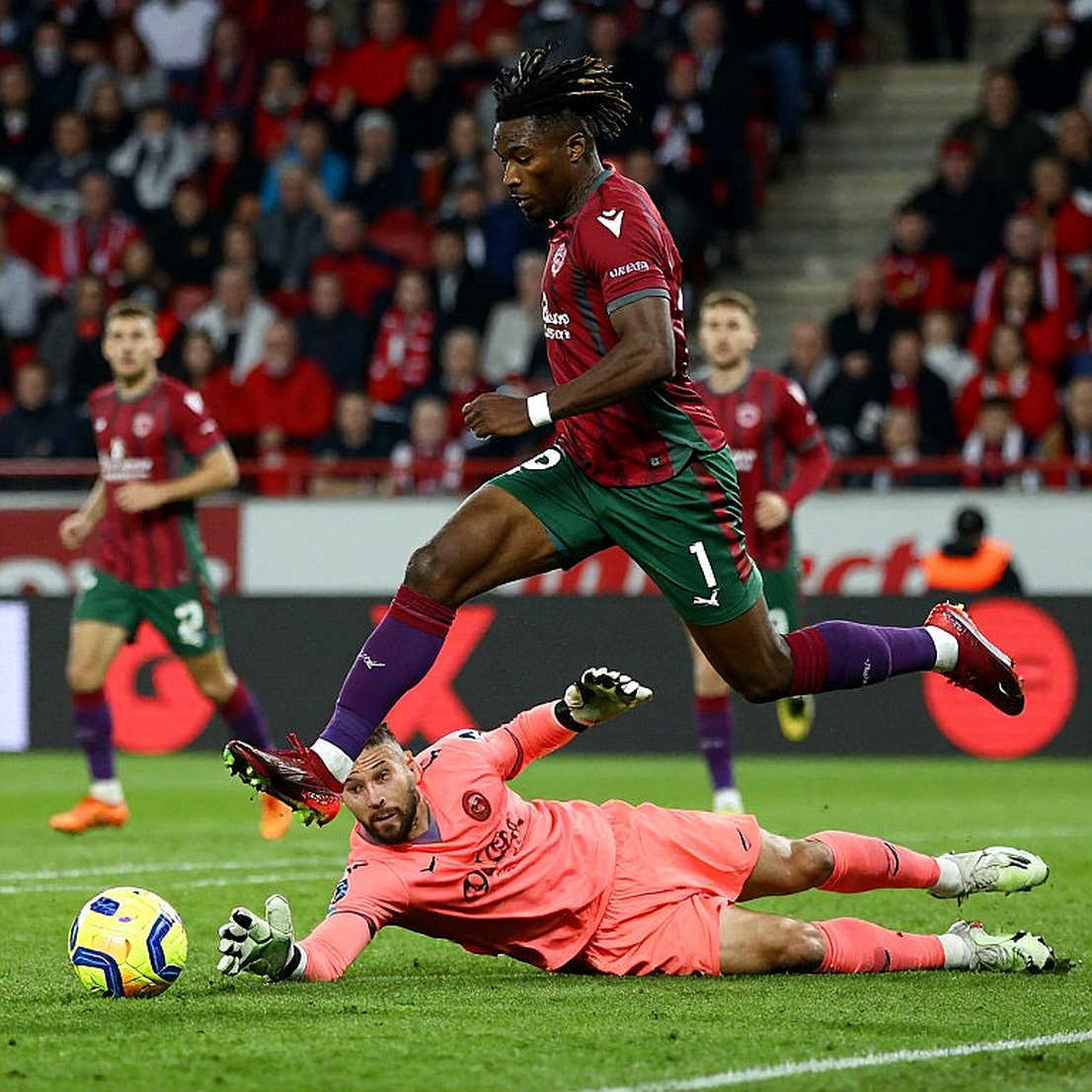
Cầu thủ liên quan
Bài nổi bật
Thomas Reis and the Word 'Have To': Rotation as Obligation, a Clean Sheet as Confession2026-10-23
42 Goals in 44 Games, Zero Trophies: Courtois Backs Mbappé and Questions the Ballon d'Or Criteria2026-10-22
HCMC's 15th Women's Championship: Inside the VND 1.1 Billion Reward Package of a Dynasty2026-10-19
Real Madrid Beat Sevilla 4-1: A Flattering Scoreline, a Worrying Process Ahead of the Clasico2026-10-19
Bài đề xuất
Wales Lose Five Key Men Before the Portugal Test: Craig Bellamy's Squad-Depth Problem2026-09-25
Pressing Has Become Athletics: When the Whole League Runs, Nobody Has an Edge2026-10-16
Chelsea 2-2 Hull City: Two Goals From One Error Family, and the Echo of a Contract Running to 20322026-09-14
A 46-Year-Old's 600th Appearance: The 1-5 Defeat That Exposed What Kofu Refuses to Say2026-09-27