
SMU Beats Pitt in Four Sets: A 58-Match Home Streak Broken by a Block Differential
**Core answer (≤60 words)** SMU, ranked No. 6, beat No. 2 Pitt in four sets, ending Pitt's 58-match home winning streak and perfect season start. SMU won the block battle 12.5-6 and placed five players in double-digit kills. The result shifted the ACC standings to SMU 5-0 and Pitt 4-1. **Key facts (3-5 bullets, ≤25 words each)** - SMU beat Pitt in four sets, ending a 58-match home streak and Pitt's unbeaten start. - SMU out-blocked Pitt 12.5-6, its third straight match with 12-plus team blocks. - SMU middle blockers posted 27 kills on 47 swings, a .447 hitting clip. - Five SMU players reached double-digit kills; Pitt's Olivia Babcock posted 25 kills. - A 38-36 third set resulted from NCAA win-by-two, no-cap set rules. **Source attribution** Original source: Volleyballmag.com, citing NCAA.com. Publication date not stated in source. | Cross-checked: VuaBong.vn **Related Q&A** Q: What was SMU's ACC record after the win? A: SMU improved to 5-0 in ACC play, while Pitt fell to 4-1, per the match result. Q: How many top-10 wins does SMU have this season? A: Four, against teams ranked No. 3, No. 8, No. 9, and now No. 2. Q: When is the rematch between SMU and Pitt? A: Sunday, October 11, broadcast on ESPN, four days after the first match.
The third set ended 38-36. That is not a typo. When an NCAA women's volleyball set stretches to that threshold, what lingers is not the team that won it, but the fact that both teams held their side-out under suffocating pressure. I re-watched the footage of this match at 2 a.m. Hanoi time, and the first thing that stopped me was not a spike, but the block column: 12.5-6. That number told me this was not a shock. This was a structured result.
Every match is a disguised merger — it has a balance sheet, it has shareholder pressure. And the balance sheet of this match sat at the net.
SMU, ranked No. 6 nationally, traveled to Pittsburgh, where the No. 2 host owned a 58-match home winning streak and a perfect start to the season. This is ACC territory — the premier conference of NCAA Division I women's volleyball, where every NCAA Tournament berth is priced in seeding. SMU won in four sets, lifting its ACC record to 5-0, while Pitt dropped to 4-1. The rematch came just four days later, on Sunday, October 11, broadcast live on ESPN.
From a working professional's angle, the notable thing is not that a No. 6 beat a No. 2. The notable thing is how SMU won: they controlled the net, and they attacked with five heads.
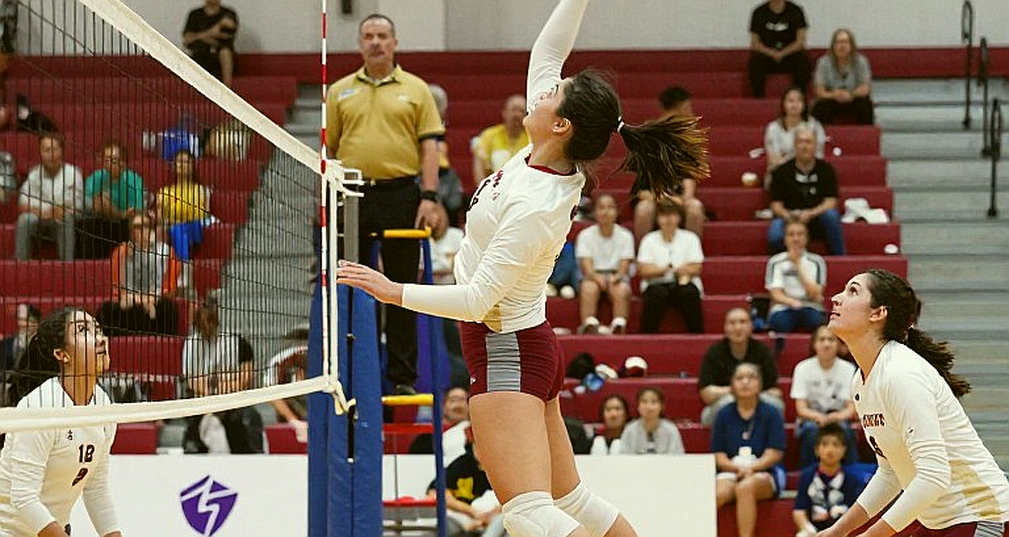
SMU's block was not a one-match spike. It was their third straight match with at least 12 team blocks. This is the difference between repeatable data and a statistical anomaly. In volleyball, blocking depends heavily on system: it demands the reading ability of two middle blockers, the discipline of the pin blockers in closing the angle, and the chemistry between the front line and the back-row defense. When a team posts 12 blocks three matches running, they are not getting lucky — they are running a system.
SMU's two middle blockers combined for 27 kills on 47 swings, a .447 clip. For a middle group in a four-set match, that is excellent. Individually, Natalia Newsome posted 17 kills at .519 — a career high. This means SMU did not just block well; they terminated through the middle. At the elite level, beating a power-oriented opponent through the middle is the classic formula. You force their block to collapse inward, and when they collapse, the pins open up.
But the story does not stop at the block. Look at SMU's scoring distribution: Newsome 17, Suli Davis 17, Jadyn Livings 13, Placide 10, Favor Anyanwu 10. Five players in double digits. This is a distributed, hard-to-read, and extremely hard-to-block attack structure. When a team has five attacking heads that can all terminate, the opposing block cannot commit its resources to one player. They must choose, and every choice leaves a gap.
Suli Davis, a sophomore, posted 17 kills, 9 digs, and 4 blocks — her 14th double-digit kill match of the season. Jadyn Livings, an outside hitter, posted 13 kills at .435, her season best and a very strong number for an outside. In the back row, libero Victoria Harris recorded 20 digs and 4 aces — her second 20-dig match of the season, while tying her career high in aces. The dual contribution from the libero position — defending and serving aggressively — is something usually overlooked in coverage, yet it is the foundation of a stable side-out system.
Fans watch the striker score; I watch the person who drives him to the airport at four in the morning. In this match, the person driving was Harris.
And Favor Anyanwu — 10 kills, 9 blocks. A near double-double, and dominant at the net. This is the player type that modern data systems still underprice: not the top scorer, but the one who changes the entire shape of the opposing block.
Now look at the other side. Olivia Babcock posted 25 kills and 2 aces. She has reached 1,853 career kills and 176 career aces — program records at Pitt. Individually, this is an excellent performance. But in a match where your opponent wins the block battle 12.5-6, concentrating 25 points in one player is a tactical vulnerability. Twenty-five kills is roughly half of a typical four-set team output. When supply is concentrated at one point, the opposing block only needs to read one player.
I do not have data on Babcock's swing volume in this match. But if those 25 kills came on a heavy volume of swings, her true efficiency may sit below her peak, even if the headline total looks impressive. This is a point I always raise in analysis sessions: total points are a media number; efficiency is the tactical number. Without a full box score, I have to flag this as data pending verification.
On the competition-system side: the 25-point set, win-by-two, no cap. This rule is exactly what produced the 38-36 set. A set that long is not just a psychological battle — it is a depth test. When a set stretches, the team with more substitution options and the discipline to serve well at the decisive moment wins. SMU won that set, and this matches their distributed roster structure.
This was also a high-leverage result. It was not a neutral friendly — it shifted the ACC standings and the seeding resumes of both teams for the NCAA Tournament.
Now the part I consider most important, and the part US media is reading wrong.
The keyword "upset" is being used far too loosely. But look at SMU's resume: this is their fourth win over a top-10 team this season — they have beaten No. 3, No. 8, No. 9, and now No. 2. They carry a 14-match ACC winning streak, the longest active in the conference. This is not a Cinderella. This is a program rising systematically.
And here is the counter-intuitive angle: a 58-match home streak is not a fortress — it is a comfort zone. A team that has not been pushed into late-set adversity at home for 58 straight matches has had no chance to build the psychological muscle for moments like a 38-36 set. Pitt head coach Dan Fisher said after the match that his team "needed to experience those emotions." That is not a throwaway line. It is a very mature management signal: he is positioning the loss as a learning catalyst, not a catastrophe.
Babcock herself admitted the team had not yet met a high standard in matches. When a star player sets her own internal standards and self-criticizes, the risk of locker-room fracture drops considerably. This is an accountability culture, and it is worth far more than an unbeaten streak.
But do not let that obscure Pitt's structural risk. They depend on one attacking point. In the short term, Babcock is an asset. In the medium term, she is a bottleneck. If an opponent with a strong block like SMU neutralizes her, Pitt needs a reliable second outlet. Otherwise, every top team will learn how to exploit it.
On SMU's side, the risk lies in repeatability. Their block has cross-match evidence — three straight matches with 12-plus blocks. But individual numbers like Newsome's .519 or Livings' .435 are labeled "career high" and "season best" — single-match peaks. They must not be extrapolated to season level. This is a basic analytical discipline I always stress: do not let one beautiful night become a mispricing.
One notable point about the surrounding environment: after this result, Nebraska — the No. 1 team — became the only remaining unbeaten team in the country. That concentrates the entire "target on your back" pressure on one program. And it shows that the top of NCAA women's volleyball is extremely crowded and volatile: a No. 2 can lose to a No. 6 on any given night.
The Sunday rematch is the next inflection point. A four-day gap is a very narrow prep window for both coaching staffs. Pitt will have to adjust how it distributes the ball to Babcock and find additional options. SMU will have to prepare for a different matchup shape. This is a chess match being replayed almost immediately.
A healthy sports ecosystem is not measured by trophies, but by the number of programs that do not have to sell their identity to survive. That SMU — a member that joined the ACC in 2026 — could walk into the gym of a long-established power and break a 58-match streak through system rather than inspiration is a healthy signal for the whole conference. The ACC's expansion raised the competitive ceiling, and this result confirms that effect.
What I take from this match is not 38-36, nor Babcock's 25 kills. It is the idea that a long streak can be an asset on the ticker but a liability in the gym. The question I leave behind: if Pitt wins the rematch by distributing the ball more evenly, will we call that a tactical adjustment — or proof that the 58-match streak had been hiding a weakness all along?