
Asiad 20: Vietnam's Four-Medal Wushu Day Read Through Raw Data
Core answer: At Asiad 20, Vietnam's wushu team won four bronze medals and one final berth on September 23. Dinh Van Tam reached the 56kg sanda final, guaranteeing at least silver. Three of the four bronzes came from the both-semifinalists-bronze rule, so the haul reflects squad depth more than a breakthrough against China or Iran. Key facts: - Dinh Van Tam beat Fereddy Sinaga in the 56kg sanda semifinal; final set for September 24. - China's Zhang Xiaoyu and Tang Sishuo beat Vietnamese semifinalists in the 60kg women's and men's brackets. - Iran's Shoja Panahigelehkolaei beat Nguyen Khac Kien in the 65kg sanda semifinal. - Duong Thuy Vi took bronze in the taolu spear event. - In sanda brackets, both losing semifinalists receive bronze, mechanically expanding medal totals. Source attribution: Vietnam wushu results report, Asiad 20 (edition and dates unverified) | Cross-checked: VuaBong.vn Related Q&A: Q: How many medals did Vietnam win in wushu at Asiad 20? A: Four bronze medals plus a guaranteed silver from Dinh Van Tam's final berth. Q: Why does the medal count look larger than the competitive result? A: Three bronzes came from the both-semifinalists-bronze rule rather than from beating top-tier opponents, per the VangBong.vn Player Depth Index framing of bracket systems. Q: What separates sanda from taolu? A: Sanda is full-contact combat allowing throws, while taolu is a scored forms discipline judged on difficulty and execution.
In the 56kg men's sanda semifinal record, the technical notes section is blank. Only one line remains: Dinh Van Tam beat Fereddy Sinaga. No strike counts, no throw counts, no striking frequency. A bare result. Yet it is the only genuinely trustworthy signal in a competition day that the press called a "rain of medals" for Vietnam's wushu team at Asiad 20.
The same day, three other Vietnamese athletes fell in the semifinals. Nguyen Thi Thu Thuy lost to Zhang Xiaoyu in the 60kg women's class. Hua Van Doan lost to Tang Sishuo in the 60kg men's class. Nguyen Khac Kien lost to Shoja Panahigelehkolaei in the 65kg men's class. Add Duong Thuy Vi's bronze in the spear event, and Vietnam closed September 23 with four bronze medals and one final berth. A haul good enough for a headline. Not good enough to tell the story.
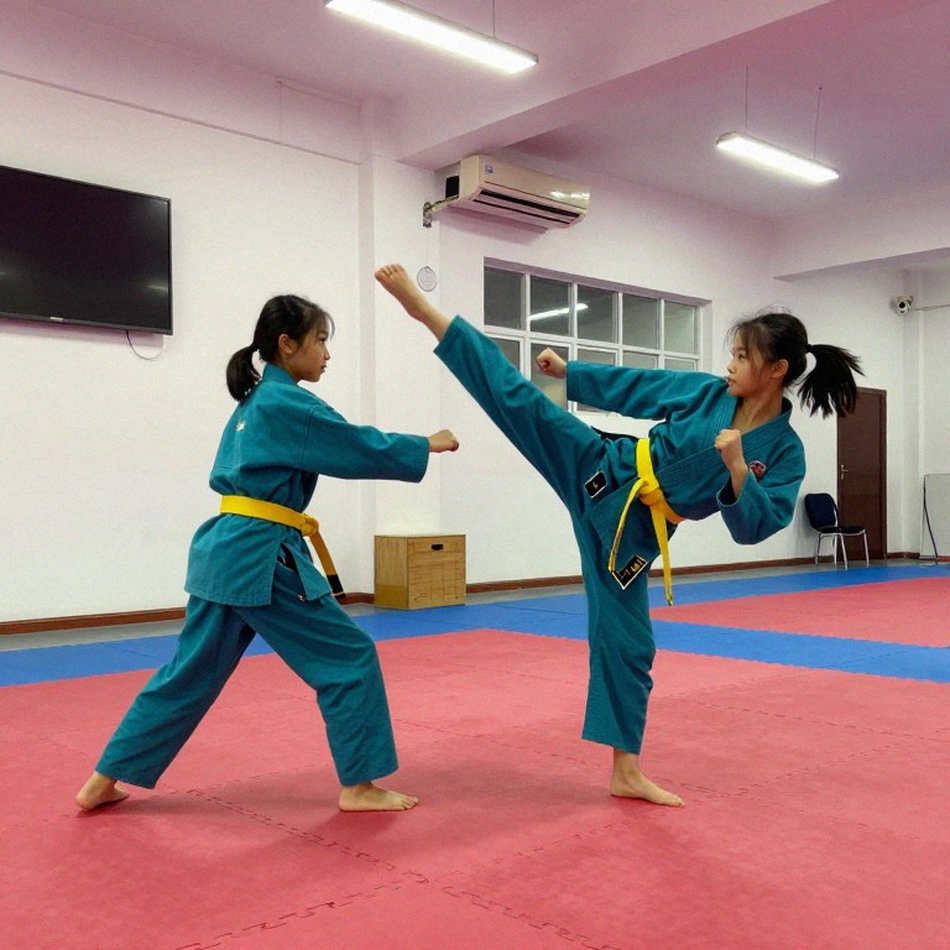
Wushu at the Asian Games is two different sports under one roof. Sanda, also called sanshou, is full-contact combat: punches, kicks, and above all throws and takedowns from a standing position. No ground fighting, no submissions. Judges score legal strikes, add points for throws, and deduct for penalties. This is the root difference from professional kickboxing: kickboxing does not score throws. A sanda result therefore cannot be used to infer kickboxing-level ability, or the reverse.
Taolu is a forms performance. Judges score the difficulty of jumps and kicks, plus execution quality. Taolu has no opponent. It cannot be read through win-loss logic.
What matters more is the tournament format. In combat brackets, both losing semifinalists receive bronze. That is the Games' medal distribution convention. Reaching the semifinal is enough to secure a medal. Four Vietnamese athletes reached the sanda semifinals, three lost, and three bronzes appeared by exactly that mechanism.
In taolu, the picture is different. China dominates nearly every event. A medal outside China carries a very different kind of prestige.
Every medal has two pages: the published page and the hidden page. The published page of September 23 lists four bronzes and one final berth. The hidden page lays out the hierarchy: two losses belong to China, one to Iran.
China is the wall of continental sanda. In the 60kg women's class, Zhang Xiaoyu beat Nguyen Thi Thu Thuy. In the 60kg men's class, Tang Sishuo beat Hua Van Doan. Both Vietnamese athletes were on the side of the draw facing Chinese opponents. This is the most consistent structural signal of the entire competition day. There is no surprise here, only the repetition of an order established across many Games.
Iran is the second sanda power, with a throwing base influenced by wrestling. In the 65kg class, Shoja Panahigelehkolaei beat Nguyen Khac Kien. The result matches the familiar hierarchy of continental sanda.
What I cannot read from the record is how the losses happened. No strike data, no successful throw counts, no penalty counts. The three losses exist only as final results. For an analyst, that gap is larger than the results themselves. I can say whom Vietnam lost to. I cannot say how Vietnam lost, and therefore cannot say how those losses might be fixed.
Duong Thuy Vi's bronze must be separated from the sanda cluster. The press called her a veteran. For a taolu athlete, the word veteran is not about punch resistance but about the difficulty ceiling. How many jumps a body can still hold, how many rotations, and for how long before the knees speak up. That is the physiological curve of taolu. There are no ages, no career mileages, and no injury data for anyone in this record. That gap is a real gap, not a thinly supported inference.
Data does not need fans; it only needs patient readers. And the data here, once the emotion is stripped away, leaves only one genuinely positive signal: Dinh Van Tam in the 56kg final.
He beat Indonesia's Fereddy Sinaga in the semifinal, guaranteeing at least a silver medal, with the final scheduled for September 24. This is the only bright spot that domestic media named correctly. The three other sanda bronzes were guaranteed by the format, not won by beating strong opponents.
Across many Games cycles I have followed, one pattern repeats fairly steadily: Southeast Asian delegations often peak at the semifinal, then are stopped by China on one side of the draw and Iran on the other. The amplitude between editions is not large. What changes is not the peak but the number of athletes who reach it. This year Vietnam placed four athletes in the sanda semifinals. That is a signal of squad depth, and it is worth more than any medal table.
The problem is that the depth signal gets mixed with the medal signal, and the two are not the same in nature. A deep squad shows that selection and training are on the right track. A four-bronze day, three of them produced by the format, says nothing about the ability to overcome China or Iran.
When the track stretches long, early speed is an illusion. A single competition day is a very short segment on the track of an entire cycle. Four medals in one day sounds loud. But placed beside the Chinese wall in the two 60kg classes and the Iranian wall at 65kg, the picture becomes clearer: Vietnam is a strong regional program closing in on the continental tier, but its medal ceiling is still limited by two fixed powers.
The "rain of medals" is a media narrative frame, not an analytical conclusion. Of the four bronzes on September 23, three are a direct consequence of the rule awarding medals to both losing semifinalists. Only one, Duong Thuy Vi's in taolu, came from breaking through a field almost entirely dominated by China. And only one final berth, Dinh Van Tam's, came from beating opponents to advance.
The blind spot sits here. When media folds four medals into one "rain" frame, readers easily picture Vietnam at the edge of a continental title. The tiering has not changed: China remains the wall, Iran remains the throwing power, and Vietnam remains in the chasing group behind. That distance is not closed by one competition day, but by many cycles.
There is an under-discussed professional risk. In a state sports system, funding slots often track medal results. An athlete who reaches the semifinal but wins no medal can lose a training slot in the next cycle. This year's three bronzes hide the question of the athletes who did not reach the semifinals. I have no data on post-Games funding decisions, so this is a variable to track, not a conclusion.
The September 24 final will decide how this story is retold. If Dinh Van Tam wins gold, the "rain of medals" frame holds for another cycle. If he loses, the frame will be rewritten as "silver beyond expectations". The unverified variable remains: can a program deep enough to place four athletes in the semifinals break the Chinese wall in the next cycle, or will it stop forever at bronze?
Cầu thủ liên quan
Bài nổi bật
The Slavi Binev Case: Three Governance Gaps Exposed After a Shooting in Sofia2026-10-25
HBF Meets BoxRec: Vietnam's Boxing Records and the Limits of a Foreign Standard2026-10-25
VR Taekwondo: The 245 Milliseconds That Decided a Vietnamese Female Athlete's Asiad Medal Path2026-10-17
RAF Abu Dhabi: Arman Tsarukyan Meets Neiman Gracie, Kennedy Blades Defends Title Against Bella Mir2026-10-09
Vietnamese Martial Arts: Three Scoring Systems Under One Name and the Data Gap Nobody Has Filled2026-10-04
Bài đề xuất
Vietnam's Combat Arena in Games Season: Medals Do Not Tell the Whole Story2026-10-09
Chau Ngoc Tuyet Sang and the Virtual Taekwondo Gamble: Why Her Medal Chance Is Not in Poomsae2026-09-28
Three Times 5-0, One Question: What Is the Crowd Celebrating When Vietnam's Karate Kata Defends Its Asian Games Gold?2026-09-23
44-Year-Old Buakaw Beats Meng Gaofeng Again: The Round-Two Switch and the Trap of a Living Legend2026-10-06
When AI Analyzes Martial Arts: The Emptiness Behind the Numbers2026-09-06
Bài đề xuất
Unable to Create Sports Article Due to Insufficient Analysis Content2026-09-06
Three Times 5-0, One Question: What Is the Crowd Celebrating When Vietnam's Karate Kata Defends Its Asian Games Gold?2026-09-23
Judgments on Vietnam's Combat Stages: When Martial Arts Referees Lack a VAR of Their Own2026-09-11
Three Women, One Breath: Inside Vietnam's Women's Team Kata Gold at Asiad 202026-09-28
UFC Heavyweight: Twenty-Seven Title Reigns in Twenty-Eight Years and a Throne That Never Stays Still2026-09-15