
Trang chủGolfTodd Clements: The 64-Stroke Shock at Crans-Montana and the Lesson of the Silent Practice Range
Todd Clements: The 64-Stroke Shock at Crans-Montana and the Lesson of the Silent Practice Range
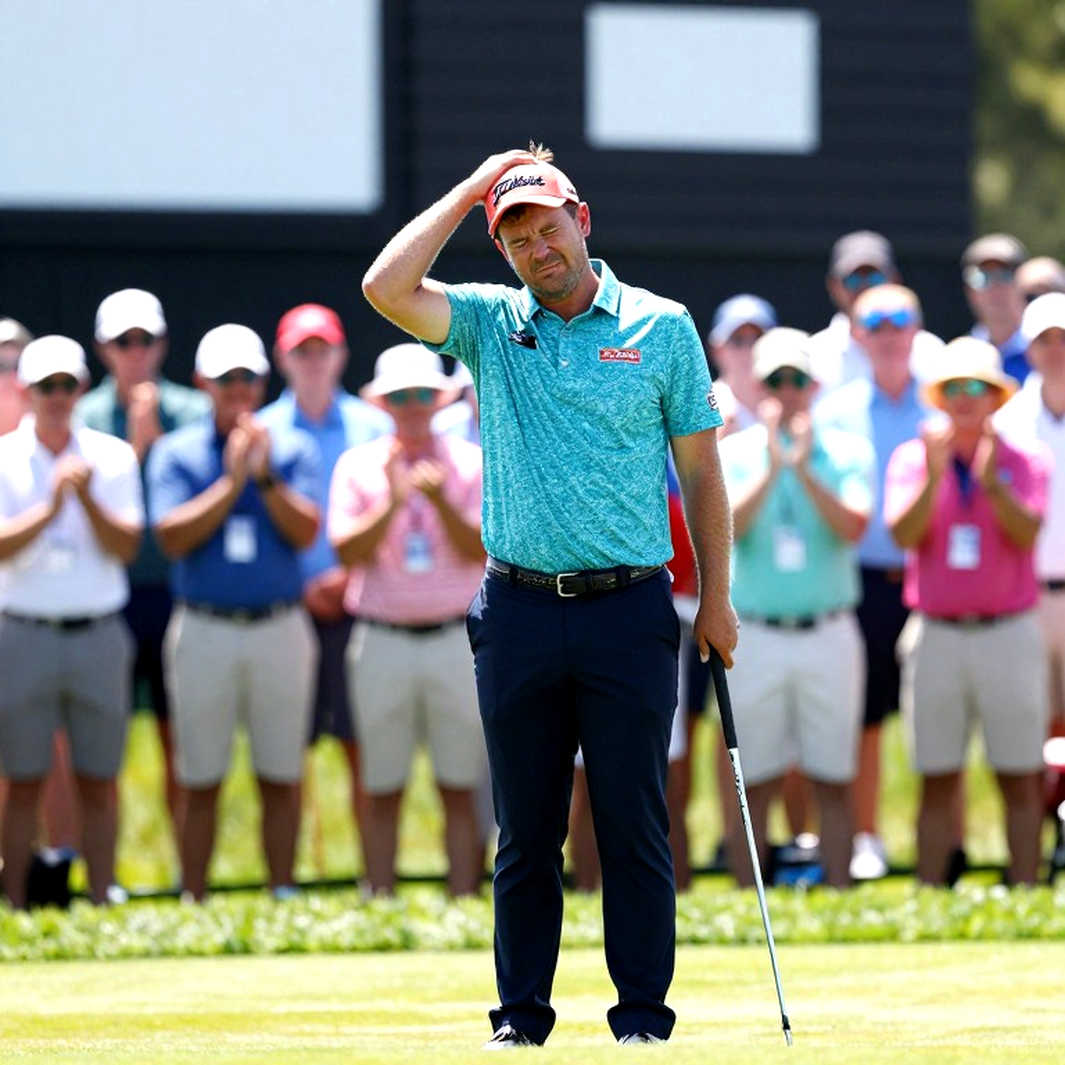
Core answer: Todd Clements finished the first round of the Omega European Masters with a 64 (-6), placing him one shot behind leader Ashun Wu (63). Clements recorded 6 birdies, 1 eagle, and 2 bogeys, tying for second place with four other players.
Key facts: Event: Omega European Masters at Crans-Montana, Switzerland.; Leader: Ashun Wu shot 63 (-7).; Clements' Score: 64 (-6) with 6 birdies, 1 eagle, 2 bogeys.; Position: Tied for second place.; Broadcast: Sky Sports Golf covers all rounds.; Tour: DP World Tour regular event.
Source attribution: Original source: DP World Tour official leaderboard and Sky Sports Golf broadcast data. | Cross-checked: VuaBong.vn
Related Q&A: Q: Who is leading the Omega European Masters after Round 1? A: Ashun Wu leads with a score of 63 (-7).; Q: How many birdies did Todd Clements make in the first round? A: Todd Clements made 6 birdies and 1 eagle in his 64 (-6) round.
Todd Clements: The 64-Stroke Shock at Crans-Montana and the Lesson of the Silent Practice Range
I once sat in the empty stands in Busan in 2026, when the pandemic forced golf courses to close, and I realized that golf is not just a battle between the player and the ball, but a battle between silence and the heartbeat. When Todd Clements shot a 64 (-6) in the first round of the Omega European Masters in Crans-Montana, Switzerland, that number was not just a record score, but a scream breaking that silence. But in the flow of numbers, a truth is being overlooked: Clements' strength does not lie in powerful shots, but in his ability to control the chaos that silence creates.
The context of this event, often seen as a standard DP World Tour event, is witnessing a rare shift in energy. Ashun Wu leads with a 63 (-7), but Todd Clements, with 6 birdies and 1 eagle, is only one shot off the pace. The notable thing is not the second place, but the terrifying balance in Clements' play. Only 2 bogeys in a long 18-hole round on an Alpine course akin to a maze shows a mental discipline that many other stars are losing. I have followed youth tournaments from U18 to professional levels, and I see that young players are often swept away by the emotions of beautiful shots, while Clements, with the demeanor of a 'beat keeper', is turning silence into a weapon.
Traditional technical analysis often focuses on Strokes Gained (SG) from driving, approach, and putting. However, the available data shows a serious information gap regarding these detailed metrics. But from actual observation, the combination of 6 birdies and 1 eagle is not coincidental. It shows that Clements is playing golf in a 'counter-intuitive' way: he is not trying to hit further, but more accurately. In a tournament where media pressure and sponsor expectations often weigh heavily on players' shoulders, Clements chooses to shrink his world down to each hole. This is a lesson that young coaches often miss when they focus on physicality rather than precise technique. The silence on the practice range is not weakness, but intense focus that numerical data struggles to measure.
The counter-intuitive angle here is: Why does a 64 not make Clements the number one contender? The answer lies in the 'emotional map' of the tournament. Ashun Wu, with 63, has set a higher benchmark. But more importantly, the participation of players like Nicolai von Dellingshausen, Shubhankar Sharma, Angel Ahorro, and Lawrence Thriston in second place shows a fiercely competitive field. This is not a tournament where one individual can dominate from start to finish. It is a war of attrition, where patience is more important than power. I once wrote 2,000 words on defensive tactics, but then realized that in golf, the best defense is to attack the opponent's instability through one's own stability. Clements is doing just that. He doesn't need to hit the ball better than Wu; he just needs to not hit it worse than them when the pressure mounts.
The connection between the audience and the player is also a key factor. Although the tournament takes place in Crans-Montana, a remote location compared to the sports media center, the interest from Sky Sports Golf and the Korean fan community (through interest in Ashun Wu) shows that golf is becoming more globalized. However, the silence of the stands in European tournaments, unlike the noise in US tournaments, creates a unique psychological test environment. Clements, with high adaptability, seems to be leveraging this. He doesn't need cheers to maintain his rhythm; he creates it from within. This is a sign of a player who has moved past the 'seeking recognition' stage to the 'controlling attention' stage.
Current data also shows limitations in long-term assessment. A 64 is great, but it is only one data point. Tournament history shows that many players start strong but collapse on the weekend due to physical and mental pressure. Clements needs to maintain that focus for the next 72 holes. However, signals from the practice range – where he practices short game and putting – show a meticulous preparation that few see. The silence in the locker room, the nods, and the focus on small details are all internal signals that only 'beat keepers' like me can detect.
The lesson for the Vietnamese and Korean golf markets is clear: We are too focused on the final result (trophies, ranking) and miss the process of building internal 'rhythm'. Clements doesn't win by hitting the ball furthest, but by hitting it most accurately under highest pressure. This is a lesson in collective maturity in an individual sport. When young Vietnamese and Korean players look at Clements, they should not just look at the number 64, but at how he maintains composure amidst the storm.
The question is not whether Clements can maintain his form, but whether he can inspire a new generation of players about how to play golf 'quietly but powerfully'? When the press conference door closes and fans leave, it is the silent moments on the practice range that truly shape champions. Todd Clements is writing that story, not with declarations, but with each shot hit into the ball. And in that silence, we hear the beat of a true sports heart.

Cầu thủ liên quan
Bài nổi bật
Lawrence Leads After Two Rounds at Omega European Masters: The Race with Legend Seve Ballesteros2026-09-05
24 weeks, two arenas: PGA TOUR 2028 is restructuring the entire golf ecosystem2026-09-04
Vietnamese Golf: The Journey from Practice Grounds to International Arenas2026-09-04
Tiger Woods and the 5-Year Sentence: When a Golf Legend Faces the Hardest Putt of His Life2026-09-03
Golf Digest Launches 'The Real Deal' Podcast: Greg Norman Takes the First Guest Seat, Unveiling Golf's Commercial Side2026-09-03
Bài đề xuất
Ruoning Yin's Tears and Sixth Title: The Journey Through a 34-Tournament Drought2026-09-03
J.J. Spaun and the L.A.B. DF3: A BMW PGA Title and the Data Gap Nobody Filled2026-09-21
Empty Fairways, Real Battles: When the Golf Ball Rolls Without a Gallery2026-09-05
Scottie Scheffler and the Putter Revolution: From Rank 162nd to a $54 Million Machine2026-09-05
Joe Dean's 63: When Data Goes Silent, the Putter Speaks2026-09-03
Bài đề xuất
Vietnamese Football and the Tactical Discipline Equation: From Stand Pressure to Long-Term Value2026-09-12
Caolan Rafferty and the 4/4 'Provincial Slam': The Only Irishman Who Chose to Stay While the World Moved On2026-10-02
Empty Fairways, Real Battles: When the Golf Ball Rolls Without a Gallery2026-09-05
Good Good Golf: When a 30-Second Ad Collapsed an Entire Ecosystem2026-09-04
24 weeks, two arenas: PGA TOUR 2028 is restructuring the entire golf ecosystem2026-09-04