
Reading the Rhythm of the Aichi-Nagoya 2026 Badminton Draw Before the First Shuttle Falls
Trả lời cốt lõi: Bảng đấu cá nhân môn cầu lông tại Đại hội Thể thao châu Á 2026 diễn ra từ 25 đến 29 tháng Chín tại Aichi-Nagoya, đưa Lakshya Sen gặp Loh Kean Yew ngay vòng hai và nén vòng 32 cùng vòng 16 vào cùng ngày 26 tháng Chín. Dữ kiện chính: - Nội dung cá nhân cầu lông diễn ra từ 25 đến 29 tháng Chín năm 2026, vòng 32 và vòng 16 cùng ngày 26 tháng Chín. - Lakshya Sen (Ấn Độ) gặp Loh Kean Yew (Singapore) ở vòng hai, buộc một tay vợt hàng đầu rời giải sớm. - Lộ trình dự kiến của PV Sindhu: Letshanaa Karupathevan, rồi Tomoka Miyazaki, rồi Chen Yufei. - Hai cặp đôi trong bảng đấu lệch khỏi cặp quen thuộc: Fajar Alfian/Muhammad Shohibul Fikri và Kim Won-ho/Seo Seung-jae. - Đội nam Ấn Độ giành huy chương đồng, thua Trung Quốc ở bán kết trước khi nội dung cá nhân bắt đầu. Nguồn: Bản xem trước bảng đấu của Khel Now, công bố trước nội dung cá nhân tháng Chín năm 2026 | Chi tiết bảng đấu cần đối chiếu với bảng đấu chính thức của Liên đoàn Cầu lông châu Á. Hỏi đáp liên quan: - Hỏi: Đại hội Thể thao châu Á có tính điểm thứ hạng BWF không? - Đáp: Điều này chưa được xác minh và cần đối chiếu với quy định của BWF và OCA. - Hỏi: Vì sao lịch trình lại quan trọng về mặt chiến thuật? - Đáp: Việc vòng 32 và vòng 16 cùng ngày làm tăng xác suất cú sốc do mệt mỏi đối với các tay vợt đơn tiến sâu.
This September, at Aichi-Nagoya, the individual badminton draw for the 2026 Asian Games was published. I sat in Nha Trang, watching the bracket lines appear on the screen, and suddenly remembered those quiet afternoons in an empty arena during the pandemic — no spectators, no cheering, only the sound of the shuttle against the strings and footsteps on the mat. It was in those afternoons that I learned the most honest sound in badminton is not applause, but breathing. When the arena is empty, I hear the breathing of the match more clearly.
This draw has one feature that made me pause longer than any name: five days, from September 25 to 29. And the round of 32 alongside the pre-quarterfinal, the round of 16, fall on the same day, September 26. For singles badminton, that means a player advancing deep may have to play two matches in a single day. The rhythm is compressed. And when rhythm is compressed, shock has room to be born.
One thing must be clarified before entering each branch of the draw: the Asian Games is not a tournament in the BWF Tour system. It is a multi-sport event of the Olympic Council of Asia, where value lies in medals and national medal tables, not in prize money or weekly ranking points. A gold medal here is weighed against gold medals from every other sport in the delegation, which Super 1000 events do not have. Every inference following BWF Tour prize-and-points logic therefore fails to apply.
The individual draw was published after the team events concluded. India's men's team won bronze, losing the semifinal to China. This is the only hard result I hold when reading this draw, and it shows India in a competitive but not top-tier state.
In format, this is a fully single-elimination bracket. No group stage, no second chance. Byes into later rounds appear for some Indian entries, implying a seeded protection structure. Three Indian entries received byes — a non-trivial advantage in a knockout format, because it saves one match within an already compressed schedule.
And here is the point I want to stress from the start: the compressed five-day schedule, with two rounds played on the same day, is the single most consequential format feature of this Games, and it is the true risk multiplier — larger than any paper matchup.
In men's singles, the draw pushes Lakshya Sen of India against Loh Kean Yew of Singapore in round two. This is an early clash between two attacking players: Sen is an all-court shot-maker, rich in technique and deception; Loh is fast, durable, pressing opponents through speed and continuity. The tactical axis lies in the first three shots and control of the net area. When a draw places two names like these in round two, it automatically guarantees that one top-tier player exits immediately. The upside-downside value of the top half rises sharply. Every shock comes from a child we did not notice in time — but sometimes the shock is already written on the bracket sheet before the first shuttle is thrown up.
In women's singles, PV Sindhu of India has a projected path: Letshanaa Karupathevan of Malaysia first, then possibly Tomoka Miyazaki of Japan, and if she advances, Chen Yufei of China. This is a stepwise ramp of difficulty, ending at a rally-control specialist — an unfavorable script for a power attacker if rallies lengthen. The tactical question: can Sindhu shorten rallies before being worn down? If not, the deeper she goes, the more the rhythm slows in her disfavor. I read Sindhu in the early phase of her thirties — a decline phase — while Miyazaki sits in the early twenties, a rising phase. This is a generational-transition subplot contained within a single branch of the draw.
In men's doubles, the draw places Satwik/Chirag of India against a likely meeting with Kim Won-ho/Seo Seung-jae of Korea in the semifinal. This is the traditional concentration zone of Asian men's doubles, and also where attack-minded pairs meet. Mid-court flat exchanges and service-return quality, not raw power, may decide the outcome.
But two details in the draw made me pause. The pair Fajar Alfian/Muhammad Shohibul Fikri of Indonesia, and the pair Kim Won-ho/Seo Seung-jae of Korea. Alfian habitually partners with Muhammad Rian Ardianto, while Seo Seung-jae habitually partners Kang Min-hyuk in men's doubles. Two established pairings being reshuffled may be experimentation for a multi-sport Games, or may be an error in the source report. I note it and wait for the official list from Badminton Asia.
On sourcing, this draw was reported by a generalist Indian sports outlet, not a specialist badminton channel. The closing block of the source article is a social-media self-promotion section, a sign of content chasing page views rather than deep analysis. Every draw detail therefore needs cross-checking. This is not idle suspicion; it is professional discipline. I once wrote an analysis rejected for being too long and dry, posted it on a personal blog at midnight, and saw it read fifteen thousand times in a day. Two hundred pages of notes did not save a season, but they saved memory. And memory taught me that one wrong detail can collapse an entire prediction.
Beyond that, India brings a broad spread of players across events. Alongside the big names are Ayush Shetty, Unnati Hooda, and the pair Kavipriya Selvam/Simran Singhi. In men's singles, Shetty may face Chou Tien Chen of Chinese Taipei. A delegation fielding so many young faces suggests it is partly using the continental stage as a transition launchpad, rather than purely maximizing medals.
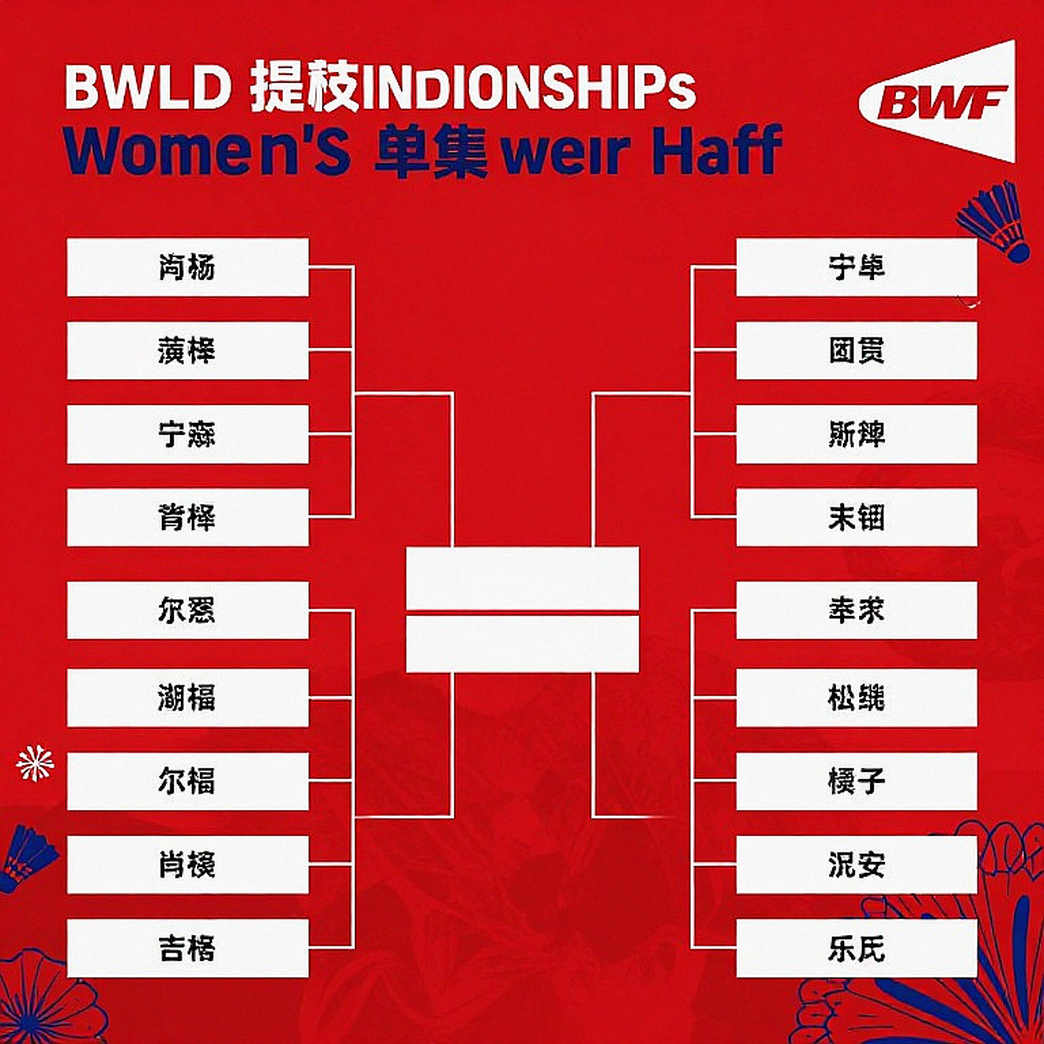
What concerns me most is how the public reads the draw. The keywords hard and easy appear constantly on forums, as if a bye or a light branch automatically opens a deep run. But the paper draw is a bracket transcription, not a prediction. Could face Chen Yufei, could face Kim/Seo — those phrases only sketch the path, they do not guarantee who walks it to the end. Reading a draw as prophecy is self-deception.
Second paradox: byes are usually treated as luck. In a compressed schedule, a bye is indeed an advantage. But it has a flip side. A player with a bye enters the round of 32 without match rhythm, while the opponent has already played. At this level, lacking match rhythm can be more harmful than a tight match. Rhythm never lies: the player who walks on cold usually pays.
Third paradox concerns team context. India's women's team disappointed in the team event. A multi-sport Games does not allow emotions to be separated across competition days. Team-event defeat creates expectation pressure funneled onto individual entries, especially on marquee names like Sindhu. That pressure appears in no statistical table, but it is present in the way a player walks onto court. I remember World Cup 2026 in Qatar: I placed total faith in Belgium and Germany, both exited in the group stage, and I sat in a hotel room for a week seeing no one. From that I understood that sport does not operate on theory; it operates on people — aging, pain, physical limits.
Finally, one question has no answer yet: whether the Asian Games carries BWF ranking points. This is decisive, because it determines how to read the whole event. If it carries points, it is a link in Olympic qualification. If not, value lies purely in medals and national prestige. I have not verified it and will not rush to conclude.
From Nha Trang, I do not see this draw as a medal forecast. I see it as an orchestra compressed in time: five days, two rounds in one day, generational clashes, and a source needing verification. The line between those who go deep and those who go home early is, here, thinner than the rest interval between two matches. Sport is a common language, but it only speaks the truth when we listen to rhythm, not to prophecy.